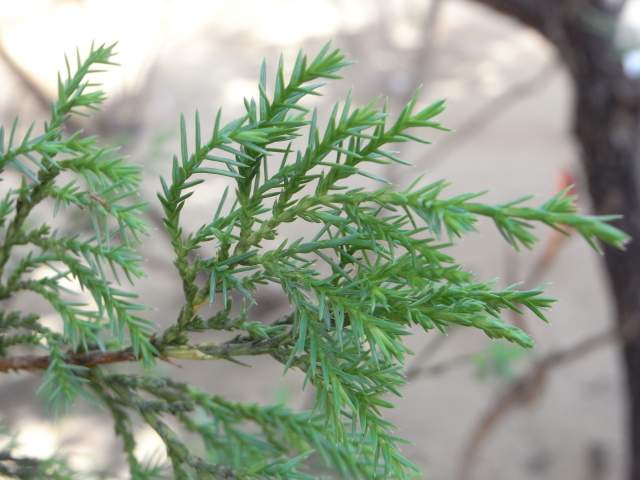
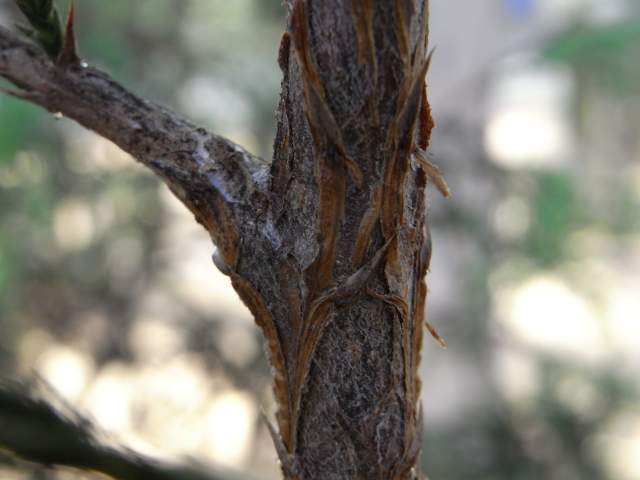
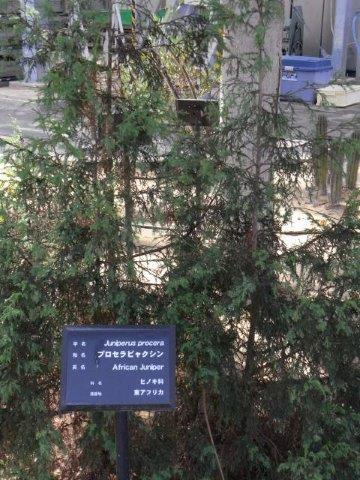
English name: African juniper, African pencil cedar, East African juniper, East African cedar, East African pencil cedar
Scientific name:Juniperus procera
Country of origin: Africa (Yemen, Uganda, Ethiopia, Eritrea, Kenya, Republic of Congo, Democratic Republic of the Congo, Djibouti, Zimbabwe, Sudan, Somalia, Tanzania, Malawi), Arabian Peninsula (Saudi Arabia)
Description
It is a coniferous tree sometimes reaching the height of 30–35 m, and in some cases, 50 m. It is the largest species among the genus Juniperus. It is the dominant species in forests in arid areas with altitude of 1,200–3,200 m. It is distributed in areas with annual precipitation of 400–1,200 mm. When it matures, it blooms every few years. It is a dioecious; the male cone is attached to the short terminal branches, and the female cone is attached to the tip of each side branch. When ripe, the female cone becomes 4–8 mm in diameter, and a maximum of 4 seeds with a length of 5 mm are attached. It tends to grow in soil with good drainage. The core material is termite-resistant. Has poor fire resistance. Propagation is performed by seeding.
Oil from sawdust is used as raw material for perfume. It is also planted as a windbreak forest. It was listed as Least Concern in the 2013 Red List of the International Union for Conservation of Nature (IUCN). In Zimbabwe, there is only one wild species remaining.
References
Farjon, A. 2013. Juniperus procera. In: IUCN 2013. IUCN Red List of Threatened Species. Version 2013.2. (www.iucnredlist.org).
Downloaded on 04 June 2014.
Hines, D.A., Eckman, K. 1993. Indigenous multipurpose trees of Tanzania: Uses and economic benefits for people. Food and Agriculture Organization of the United Nations. Ottawa, Ontario, Canada. (http://www.fao.org/docrep/x5327e/x5327e00.htm#Contents)
Orwa, C., Mutua, A. , Kindt, R. , Jamnadass, R., Simons, A. 2009. Agroforestree Database: a tree reference and selection guide version 4.0 (http://www.worldagroforestry.org/sites/treedbs/treedatabases.asp)